A Letter From Dave to His Dad
Introduction
When the Dave Brubeck Quartet performed at the White House in June 1986, The Washington Post reported: “After an encore of ‘Take the A-Train’ that had even the crystal chandeliers twirling, President Reagan told Brubeck, ‘I don't know how much easier you could shed 50 years in so short a time.’”
Dave Brubeck had long been a household name since at least 1954, when he was the focus of a Time magazine cover story on the rebirth of American jazz. Perhaps you have heard his famous Quartet (with Joe Morello, Eugene Wright and Paul Desmond). There classic album Time Out was an international sensation, sold well over a million copies, and became the first gold record for modern jazz.
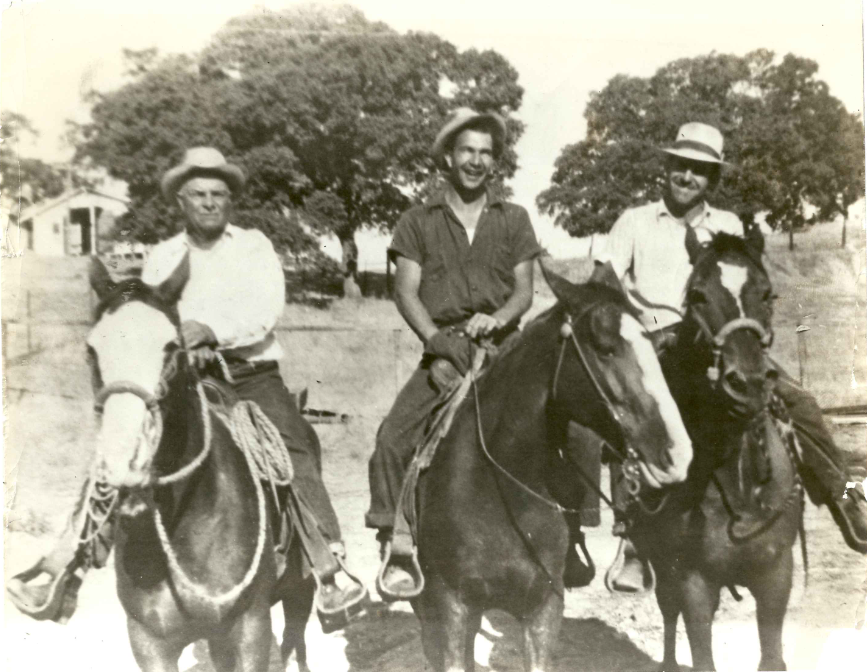
Dave was born in Concord, California. His mother, Elizabeth, was a pianist while his Dad, Howard ("Pete") Brubeck, was a cattle rancher. When Dave sent me the photo following, he said, "I am entrusting you with the ONLY photograph I have of my father and me together.."
(Father, "Pete," on the left, and sixteen-year-old Dave, in the middle.)
Dear Dad,
When I am in some distant spot on the globe, performing before people whose lives and ways are so different from anything you or I have known, I often ask myself, "What would Dad think of me now?" I guess that's what I most want to know, even now when I am almost the age you were when you died. What do you think of me, Dad?
And to you, I want to express my eternal gratitude for your allowing me to pursue my own career, even though it meant the end of our sharing a common way of life on the ranch. After Henry and Howard became musicians, I was your last hope for a cattleman, wasn't I?
I knew it. And I honestly tried all through that first miserable pre-med year at college, when it still seemed possible that I could become a veterinarian and remain with you on the ranch. Not once did you voice your disappointment when I switched to music my second year. In fact, you seemed to understand my emotional needs better than I, because you found a way to make me feel less guilty and to keep our mutual dream alive by agreeing that if things did not work out in music, I could always come home and be partners with you.
Knowing this, I never felt completely defeated, even when times were most desperate. And there were a few rough seasons when I did return home with my wife and young family for brief stays.
I remember that just after my discharge from the Army (Spring of 1946) you asked me to join you driving cattle to the mountains. I figured that after being in the Army three and a half years, I was in good enough shape to keep up with "the old man," so [I] started out with you around 3 a.m. and by noon it was obvious that I was so sore there was no way I could remain in the saddle one more minute.
Knowing that you did not take kindly to any confession of tiredness or soreness, I was grateful to be bringing up the rear, while you were riding at the head of the herd. So I got off my horse and started walking, leading the horse and hoping some feeling besides pain could return to my legs and seat before you spotted me. No such luck! Just as you knew every steer, cow and calf by their idiosyncracies [sic], you could spot anything out of the ordinary a mile away. I can still see you riding back to me. I was suddenly a child again.
"Either you get back on your horse, or put him in the truck. You can drive along behind in your truck. But don't ever let anybody see Pete Brubeck's son leading a horse!"
We both felt humiliated, angry and sad. I think that was the turning point, when it was clear to us both that our lives would really diverge.
But thank God for the truck, because we were to keep going another eight hours before we camped for the night.
The cattle were so worn out they gladly settled down near the road, and we slept on the ground with only our saddle blankets for cover. You may have considered this a night's rest, but I think I got more sleep in the mudhole in Verdun.
It has been forty years since I left the cowboy and ranch life, but it has always remained a part of me. You, your friends, and the generation before you, who walked to California from the East to carve out a new life in the West, have influenced me more than you know. I admire your toughness, tenacity, honesty and humor. You taught me how to channel anger and frustration into a good life no matter what the circumstances; and your example of inner strength and self-reliance has sustained me.
“I admire your toughness, tenacity, honesty and humor. You taught me how to channel anger and frustration into a good life no matter what the circumstances; and your example of inner strength and self-reliance has sustained me.”
I can think of no man I would rather be with right this moment. We'd share lots of laughs and good memories. Remember when you won the calf roping event at Salinas? And the time they talked you into entering the calf roping contest at the Sutter Creek Rodeo? You were 65 years old. And you said, "give me a young man at the fence to run in and do the tying after I've roped him” — and you won!
Boy was I proud of you!
Love, Dave
Originally published in The Dave Brubeck Quartet newsletter Winter/Spring 1990-91 Issue
© Derry Music Company, Inc.