What Does America Sound Like? The Dave Brubeck Quartet’s Jazz Impressions of the U.S.A.
By Jacob Slattery, July 2026
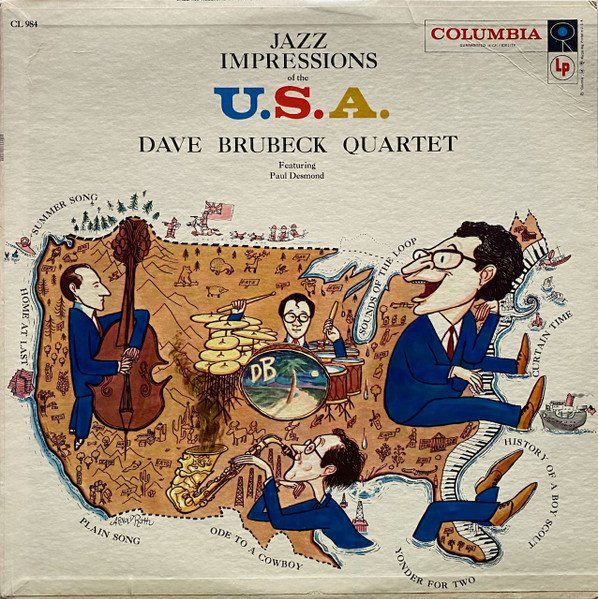
Jazz Impressions of the U.S.A. (Columbia Records, 1957). Original cover art by Arnold Roth.
What does America sound like? For Dave Brubeck, the answer was found not in fireworks, hot dogs, or patriotic marches, but in the lived American experience. Touring across the United States in the 1950s, Brubeck and his Quartet encountered America in the rhythm of a Greyhound bus, the vast openness of the Great Plains, the clanging of the commuter rail, the joyful spirit of New Orleans jazz, the anticipation of a Broadway curtain rising, the memory of summers away from the city, and the quiet peace of returning home.
As the bandmates traveled from one engagement to the next, the sights and sounds of the road sparked musical ideas. Brubeck observed that “a music notebook is as important to the traveling musician, as a sketch pad is to the artist,” recalling themes emerging from "the drone of the plane, the rumble of the bus, the clack of the rails, the hiss of the radiator in a strange hotel room." These “scribblings”, as Brubeck put it, became Jazz Impressions of the U.S.A. (Columbia Records, 1957), the Dave Brubeck Quartet’s jazz travel diary of a nation, captured through eight distinct portraits of American life.
Recorded in New York, Hollywood, and Oakland, the album itself was a product of movement. The cover depicts the electrified Quartet members sprawled across a map of the continental United States, with a piano keyboard running all the way down the Eastern seaboard, surrounded by illustrations reminiscent of Plains Native American ledger art tradition. The original artwork was drawn by celebrated cartoonist and illustrator Arnold Roth, whose visual collaboration with Brubeck began with Jazz at the College of the Pacific (1953).
The album’s compositions highlight the individual contributions of each member of the Quartet—Paul Desmond on alto saxophone, Norman Bates on bass, Joe Morello on drums, and Brubeck on the piano—at a pivotal moment in the group’s sonic evolution. Their distinct personalities combine into a united sound, reflecting a balance of individual expression and honest collaboration that is profoundly emblematic of America: a place defined not by one person alone, but by many voices and perspectives coming together in pursuit of something shared.
“Much of the folk music of America has become integrated into jazz and conversely, jazz has affected folk music itself, so that today we find endless cross-influences.” –Dave Brubeck
The journey begins in the American West. “Ode to a Cowboy” draws upon the imagery and folklore of the frontier, recast through an imaginative jazz lens. Although the subject matter is evocative of his own upbrining, Brubeck describes the composition as a collective effort: Paul Desmond’s alto saxophone, “the plaintive voice of a singing cowboy”; Norman Bates’s bass, the cowboy’s “guitar accompaniment”; and Joe Morello’s drums, the cowboy’s “sole companion”.
From the open range, Brubeck turns inward with “Summer Song.” The melody, he explained, recalled “peaceful golden summers away from the city.” The song paints a timeless American scene: children swimming, fishing with willow poles, boats drifting around a bend. Yet beneath its warmth is a gentle awareness of passing time, expressed in the lyrics Brubeck wrote with his wife, Iola: “Why must summer ever end?”
“Yonder for Two” looks further back, paying tribute to the early New Orleans jazz musicians who helped forge the foundation of the music that inspired Brubeck. The composition preserves some of the two-beat feeling of that tradition, celebrating the joy, energy, and spontaneity at the heart of early jazz. Throughout Brubeck’s career, history remained an ongoing conversation, with each new generation adding its own voice to the music that came before.
Despite its playful title—coined by Desmond with an homage to Stravinsky’s Histoire du Soldat—“History of a Boy Scout” carries a deeper sense of reverence. Brubeck described it as a mixture of humor and respect, containing both “the skyrocketing spirit of a Fourth of July parade” and an awareness of sacrifice and remembrance. Its military echoes and contrapuntal writing reflect on the service of individuals who shaped the country’s collective memory, from Valley Forge and Gettysburg to the battlefields of the 20th century.
Perhaps no track captures the physical world more vividly than “Plain Song.” Brubeck wrote it while traveling by bus between Yankton, South Dakota, and Iowa City. The steady pulse of the bass and drums suggests “the monotonous revolution of wheels upon a journey which has no end,” while the spacious piano writing evokes the vastness of the Great Plains. Desmond’s alto saxophone becomes the voice of solitude across the immense landscape.
With “Curtain Time,” Brubeck moves from the open countryside to the excitement of Broadway. The music captures the anticipation of a theater before the performance begins: the lights, the energy, and the promise of something about to begin.
“Sounds of the Loop” brings listeners into the heart of Chicago. Here, Joe Morello takes center stage, turning his drums into a one-man soundscape of the urban life. Brubeck imagined the piece as capturing “the clanging of the el train, the roar of the traffic, the hubbub of Chicago at rush hour.” Having joined the Quartet the year before, in 1956, Morello’s distinctive rhythmic personality emerges on this track, offering an early glimpse of the inimitable contribution he would make to the group’s evolving identity.
The journey concludes with “Home at Last,” recorded in Brubeck’s own house after the completion of a national tour. Following the movement and discovery of the previous tracks, it offers a moment of reflection that Brubeck personally described as “the calm of the Bay, the quiet of the hills, the warmth of the fireside, the love of the family—all felt with increased poignancy after my long absence.” In his liner notes, he so elegantly offered this fitting conclusion: “After traveling across the country, the wanderer has returned.”
As the United States celebrates its 250th anniversary in 2026, Jazz Impressions of the U.S.A. remains a compelling reflection of the nation’s character. “Much of the folk music of America has become integrated into jazz,” Brubeck wrote, “and conversely, jazz has affected folk music itself, so that today we find endless cross-influences.” Brubeck’s vision lies at the heart of both jazz and the American experience.
So, what does America sound like? Through Brubeck’s ears, it sounds like movement and memory: wheels turning on an open road, children laughing on a summer afternoon, trains passing through a crowded city, a theater waiting for the curtain to rise, and a wanderer finally returning home. His album offers a reminder that the American story is one of endless variety, where different traditions meet, influence one another, and leave behind their own impression.
Sources: Liner notes by Dave Brubeck, 1957, Jazz Impressions of the U.S.A. (Columbia Records, 1957).